
New place, new challenge
Moving to a new place, always has its challenges. I knew, from the outset, relocating from the warm sub- tropical climate of Durban, on the East Coast of Africa, to the cooler, West Coast would not be without difficulties.
Blinded by a pretty face
Some of these problems I anticipated and adjusted accordingly, the insane traffic queues is one that springs to mind. Others, I had no clue about. Never, in my awe at living in one of the most beautiful cities in the world, did I imagine that I would have to deal with a vermin invasion.
Always a farm girl
Before I share my ‘tail’ of woe, and our creative solution, I need to explain a few things. Essentially, I am a farm girl at heart.
Benefits of a rural childhood
I grew up on a small farm. I drank fresh jersey cow, full- cream milk, everyday. We had eggs, and meat from our free ranging chickens, raw, organic honey from my father’s hives and fresh produce from my mother’s bountiful vegetable garden.
More like the ant than the grasshopper
Once a year, when the orchard was laden with sun kissed apricots, and downy peaches, my mother would go into production mode. We were put to work stoning the fruit that, through some strange process of alchemy, filled the house with heady scents, and became delicious pots of jam.
Living off the land
We were not farmers; we just lived close to our patch of earth. My mother taught at a nursery school, and my father was a meteorologist, working for the civil service. With five children in my family, and not a lot of spare cash, extras were provided for by my father’s apiarist hobby, and our nutritional needs met by my mother’s green fingers.
Along with gardening for pure pleasure, a legacy from my mother, growing food is what I know, and I have always had a little vegetable patch wherever I have set up home. Cape Town was not going to be an exception.
Monkeys and Mould
Growing vegetables in Durban, is somewhat challenging. Hot, humid summers are not the most ideal growing conditions. Mild, warm winters do give Durbanites an edge in that they can grow summer crops like lettuce, and tomatoes. The real challenge here is the vervet monkeys. Thanks to habitat encroachment, they will raid your veggie patch without hesitation. I made my peace with them, they are noisy and you can hear them coming, this usually gave me time to head them off.
Anticipation of a fresh new start
The first priority, when we moved, was allocating a sunny patch in our small, urban garden to food production. As our soil is poor and sandy, we established our vegetable beds in raised planters and big pots. I couldn’t wait to start. Finally, we could grow things like carrots and parsnips, not possible in our Durban garden.
Reality bites
To my consternation, nothing thrived. I would plant seeds that failed to germinate. Seedlings withered, and fruit would disappear before it ripened.
Midnight feast
It made no sense, at least, not until the night we discovered a large rat sitting in our bird feeder, cheeks bulging with his delicious find. I still failed to make the connection. We started bringing the bird feeder in at night, in an effort to deter the rats, especially as the number visiting the feeder seemed to double everyday. This did not dissuade them, and my dogs would sit for hours at the grid over a storm water drain, hoping some rat would be foolish enough to stick his nose out.
Roving Rodents
The rats seemed to be coming from the small school next door to our house. The school stores their bins in the servitude between our properties. The rats used the storm water sewers to travel in and out of adjoining properties.We stopped putting seed out, but still they invaded.
I still had not credited the ‘failure to thrive’ state of my vegetable garden to the rat problem. It was only when I found the pulpy remains on the vine of my solitary success of a cucumber, that I realised it was the cunning rats who were decimating my garden.
Under siege
With an uncanny ability to climb, dig and swim nothing is safe from rats. When I placed transparent, little yoghurt cups over my seedlings to protect them, they simply gnawed a neat little hole through the cup.
No poison ever
Poison is never an option for me, besides a real fear of my own pets becoming secondary victims, we have a number of raptors in the area. The risk of an owl or an eagle, eating a poisoned rat, is something I was not prepared to take a chance on.
Seeking an environmentally friendly solution
We had to make it impossible for the rats to access to the vegetable garden in the first place. We looked at small, green houses but the option was to swathe them in plastic, (ineffective against rats), and in sweltering Cape heat, hardly a solution.
The other option was to cover it in netting, again something a rat would gnaw through in seconds, it needed to be covered in wire mesh for us to stand a chance.
Repurposing the bird aviary concept
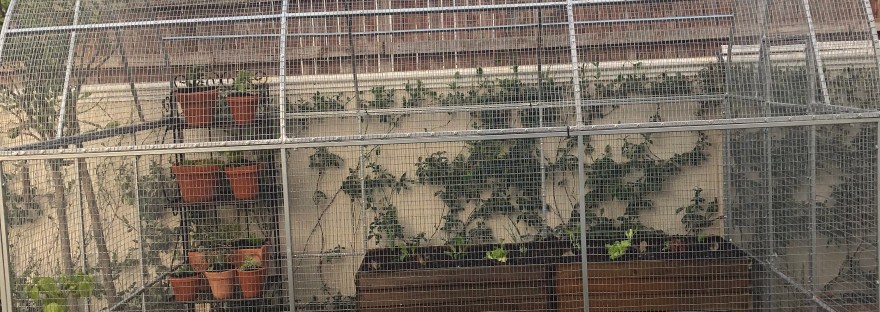
That’s when we realised if we built a large, steel bird aviary, (birds don’t belong in captivity anyway) and used that to grow our vegetables in, we may just have a solution. A quick internet search and we found a local company who built our veggie “cage” to our specifications.
Hoping the hard work pays off
It took two days of hard labour; assembling it, lining the floor with chicken mesh, and installing the planters. I spent a happy four hours, planting up my new space, it’s so pretty and I love it.
Now all that remains is to see if we have fooled the rodent population.


