
Changing up our usual Kruger experience
Like most years we ease into the mayhem with a week- long family holiday to the Kruger National Park. Having timeshare at Ngwenya Lodge, situated close to the Crocodile Bridge entrance, we tend to restrict ourselves to the South of the Park.
However, as much as we enjoy Ngwenya and its beautiful aspect on the Crocodile river, we felt we needed to reacquaint ourselves with the joy of staying in the Park itself.
Why change our usual holiday habit
Over the last few years we have felt a little restricted and frustrated with our visits. A number of combined factors have led to this.
Firstly some of the family have now experienced overlanding to some fairly wild parts of Africa, including South Luangwa in Zambia, Mana Pools in Zimbabwe, the Central Kalahari in Botswana. They are looking for something more, from their local experience, than ticking off the big five, between Crocodile Bridge and Lower Sabie rest camp.
Secondly, the Kruger Sightings twitter feed has spurned, in our humble opinion, a deplorable group who seem to race through the Park from Lion sighting to Leopard sighting, ticking off the list and grabbing the photo for instagram.
There appears to be little appreciation of the incredible bush veld and it’s treasures, which can only be fully appreciated by taking it slowly, and allowing your inner eye to really see what is there. I suspect it’s the same group who behave with such aggression, at a sighting; jostling cars for best views, with no regard for others, hogging the sight, and some even hooting and swearing.
I hasten to add that it is a small group, and whilst all are entitled to enjoy their holiday as they wish, we choose not to do it this way. Whatever the reason we felt we needed to regain our love for a beautiful place.
Charms of the small bush camps
We chose to split our holiday between two smaller bush camps in the Park, and spent one night in one of the bigger rest camps.
The difference between the bush camps and the main rest camps, is that the main camps are large, often include camping, and have amenities like shops and restaurants. The bush camps are smaller, often more remote in location, with more basic accommodation and no shops or restaurants.
As luck would have it schools re- opened earlier this year, so the Park was comparatively quieter than last year. This made our bush camp experience even more special as so few people were in the camp.Whilst accommodation may not be what you consider five star, it is clean and comfortable with all the basics you need, and friendly staff. Despite the heat, nothing beats the magic of a small camp, deep in the bush.
Biyamiti bush camp is set amongst beautiful trees, along a river (dry when we got there, flowing when we left, thanks to a thunderstorm). From here we had incredible sightings of wild dog, lion, leopard, rhino, and our bird count increased rapidly.
Our second camp, Bateleur, is the oldest and smallest bushveld camp. It’s set in the North, in the Mopane veld.
We loved the private access to two dams in the area. Here we had great waterbird sightings including the Saddle-billed stork, as well as hippo and crocodile.
I loved the woodland setting, around our unit, which was a constant buzz of birds. The loud trill of the woodland kingfisher is my favourite alarm clock.
Talking of birds, if you can deal with the heat, January is a wonderful birding month you want to see all the summer visitor species. There were huge numbers of raptors throughout the Park including the beautiful Bateleur for which the camp is named.
Again, an abundance of big game, including elephant and giraffe, were to be found and lots of interesting, small creatures to keep my photographer sons happy.
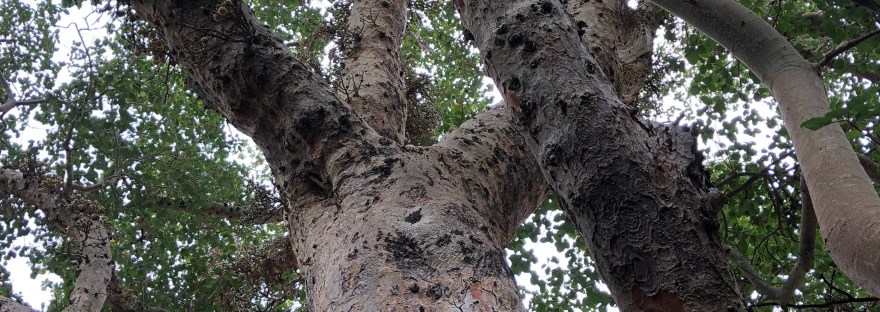
Being the tree hugger in my family I was entranced by the huge jackalberry trees (diosypros mespiliformus),the Natal Mahogany (trichelia emiticus), sycamore figs (sycamorus ficus), the stately lala palms (hyphaene coriacea), in the area. Even my ultimate favourite the baobab (Adonsonia digita), was found close by.
As always a week speeds by too quickly, and before we knew it we were back on the road, wending our way home. All in all, it was a great way to start the new year.
Rewards of staying in the Kruger Park itself
Among the advantages is the fact that you gain access to the Park half an hour earlier than the day visitors, four thirty am in summer. Great for early morning photography and often early enough to catch the nocturnal animals returning to their dens.
if you, like us, are tired of Kruger traffic jams, and want to reconnect with the thrill of finding your own sightings be they big, small or feathered, choosing a remote bush camp is a great way to go.
If you are happy to let nature come to you, rather than turning it into a desperate case of oneupmanship nothing beats the charm of the smaller camps, and I suggest you try them as an alternative way to experience, what still remains, one of our well deserved national treasures.

 brenfinding5th.com
Great post 🙂
LikeLike